go to main page
go to bowl index page
(normally, this window is loaded as a pop-up, so you should just close it)
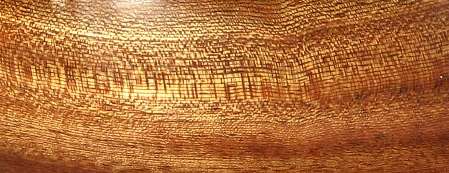
Chatoyancy: the property whereby something reflects light quite differently depending on the viewing angle. With wood, this can be really striking, especially in pieces with ray flakes, which can go from dark to light as you move the wood's angle in the light. On wood with large ray flakes, the flakes themselves can change color in an obvious and attractive fashion, but where chatoyancy really applies is in woods with multitudinous small ray flakes that cause the entire surface of the wood to change as you move it in the light. It gives the wood a "shimmer" that just can't be captured by still photographs. There are other wood grain characteristics that can create chatoyancy besides ray flakes. It can be particularly striking in woods that have "interlocked grain" that creates a "mottle" figure and it can also show up in woods with a "curly" figure. Going into the details of interlocking and mottle and the reasons for curl seems far afield from bowls so I'm not going to get into those details. The point is that wood can have chatoyancy for quite a few different reasons and it can be wonderful to behold. Having said that it can't be captured by a still photograph, I will now produce a still photography which does not demonstrate chatoyancy but which is of a piece of wood that DOES show beautiful chatoyancy. This is a section of bowl #S3 after the polyurethane was applied. The wood is sipo and the chatoyancy in this case is due to multitudinous small ray flakes.
sipo (with a polyurethane finish) showing multitudinous small ray flakes that create a very strong chatoyancy
click on the image to enlarge it